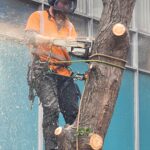
The best time to prune a silver birch is late summer to mid-winter, roughly August to December, once the sap has slowed. Avoid pruning from late winter through spring, when birch sap rises early and runs from fresh cuts. The bleeding itself does not harm the tree, but pruning outside this window is tidier and gives cuts the best start. Silver birch needs very little pruning, so only cut when there is a clear reason, such as deadwood, clearance or safety.
When is the best time to prune silver birch?
The best time to prune silver birch (Betula pendula) is from late summer to mid-winter. The RHS advises avoiding birch pruning where possible, and otherwise pruning between late summer and mid-winter, when sap flow is low and cuts close over before spring.
In practice, for Essex gardens that means:
- August to October: the ideal window. The tree is still in leaf, so it is easy to see dead branches and judge the shape, and cuts have time to start sealing.
- November to December: still fine for most work, once the leaves have dropped.
- January to May: best avoided. Birch sap starts rising in late winter, well before buds open.
- June and July: possible for light work, but the tree is in full growth, so we usually wait a few weeks.
Why do silver birch trees bleed when pruned?
Silver birch bleeds when pruned because its sap starts moving very early in the year, from late winter into spring. Cut a branch at that time and sap can drip or run from the wound for days or even weeks.
It can look worrying, but bleeding does not harm a healthy birch. The RHS says bleeding from pruning cuts is usually not harmful and heals naturally over time, and many arborists now see the sap as part of the tree’s own defence. It forms a moist layer over the fresh wound and may help stop fungi and bacteria settling on the cut while the tree seals it.
So if a birch has already been cut in spring and is bleeding, leave it alone and let the tree do its job. Wound paint or sealant is no longer recommended, as it can trap moisture and disease against the cut. We still prefer to prune birch between late summer and mid-winter, though. Spring bleeding can drip onto paths, cars and patios for weeks, and research on silver birch in Finland found that pruning wounds made in May were the most open to fungal infection.
Does silver birch need pruning at all?
Silver birch rarely needs pruning. It naturally grows into an elegant, airy shape, and heavy cutting can spoil its form and weaken it. Most pruning on a healthy birch is limited to a few specific jobs:
- removing dead, damaged or diseased branches
- crown lifting, to raise low branches over a lawn, path, drive or road
- removing crossing or rubbing branches on young trees
- shortening a branch that touches a roof, wall or window
Silver birch should never be topped or cut back to bare stumps. Birch does not respond well to hard pruning, and the regrowth from large cuts is often weak and prone to decay. As with every tree we work on, the Crown Tree Services team’s aim is to leave a birch healthier and safer, not just smaller.
Can you reduce the height of a silver birch?
You can reduce a silver birch, but only lightly and with care. A professional crown reduction removes a small amount from the outer crown, cutting back to suitable growth points so the tree keeps its natural shape. Taking off too much at once can stress a birch and lead to dieback.
Silver birch is a fast-growing but relatively short-lived tree, often reaching 15 to 25m and living for around 60 to 90 years. If a birch is simply too big for its spot, a well-planned tree crown reduction or crown thinning is usually the better first step. Where a tree is declining or unsafe, we will talk you through the options honestly, including replanting with something better suited to the space.
How should you prune a silver birch?
Prune a silver birch with clean, sharp tools, making small cuts just outside the branch collar, the slightly swollen ring where a branch joins the trunk. Smaller cuts heal faster and leave the tree less open to decay.
- Check the timing: late summer to mid-winter only.
- Start with dead, damaged and diseased wood.
- Remove crossing branches and any that rub.
- Take out as little live wood as possible, and never more than about 10 to 15% of the crown in one go.
- Step back regularly to check the shape from the ground.
Anything above head height, near a building or close to power lines should be left to a qualified tree surgeon. Birch wood is light but brittle, and branches can split unpredictably.
It is also worth checking whether your tree is protected. Many trees in Essex are covered by Tree Preservation Orders or sit within conservation areas, and pruning them without consent can lead to a fine. The Crown Tree Services team checks the status of every tree with your local authority before work begins.
Book silver birch pruning in Essex
Crown Tree Services prunes silver birch across Essex at the right time of year and to British Standard BS3998:2010. Our qualified, fully insured arborists are based in Ongar and provide domestic tree care throughout the county.
We cover areas across Essex, including tree surgeons in Chelmsford, tree surgeons in Howe Green, tree services in Billericay and tree surgeons in Basildon, along with the rest of the areas we cover in Essex.
Contact us online to book your silver birch pruning with a free site visit and fixed, no-obligation quote, or call us on 01277 525150.
About the Author: Stephen O'Reilly