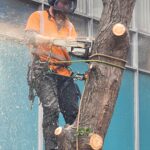
In short: In some cases, you can cut down a tree in your own garden in England without permission. You do need council consent if the tree has a Tree Preservation Order (TPO) or stands in a conservation area, and you may also need to check planning conditions, nesting birds and felling licence rules. Many trees across Essex are protected, so always check before any work starts.
At a glance
- Garden trees: some trees require no permission, unless the tree is protected.
- Tree Preservation Orders (TPOs): written council consent is needed, and councils usually take around eight weeks to decide.
- Conservation areas: six weeks’ written notice for any tree with a trunk over 75mm across, measured 1.5m above the ground.
- Dead or dangerous protected trees: five working days’ written notice to the council, unless the danger is urgent.
- Felling licences: not needed for trees in gardens, orchards, churchyards or public open spaces.
- Nesting birds: active nests are protected by law, and the main nesting season runs from around March to August.
Do you need permission to cut down a tree in your garden?
You do not usually need permission to cut down a tree in your own garden, as long as the tree is not protected. The main exceptions are:
- Trees covered by a Tree Preservation Order
- Trees in a conservation area
- Trees protected by a condition on a planning permission
Before you think about removal, it is worth asking whether the tree really needs to come down. A tree that has simply outgrown its space can often be kept with careful crown thinning or a tree crown reduction, which lets in more light and reduces its size while keeping a healthy tree in your garden. At Crown Tree Services, we always look at whether a tree can be kept before we talk about felling.
Which trees are protected in the UK?
No species of tree is automatically protected in the UK. Oaks, yews, silver birch and monkey puzzle trees are all treated the same way. A tree is protected because of where it stands or because a council has made a specific order, not because of its species.
A tree is protected if:
- it is covered by a Tree Preservation Order made by your local council
- it stands in a conservation area and its trunk is more than 75mm across, measured 1.5m above the ground
- a planning permission includes a condition requiring it to be kept
- it is subject to a restrictive covenant on your property’s deeds
Mature and veteran trees are often protected. In Essex, protected trees are especially common around Epping Forest, in the older parts of Brentwood and Chelmsford, and in village conservation areas.
What is a Tree Preservation Order?
A Tree Preservation Order (TPO) is a legal order made by a local planning authority to protect a specific tree, a group of trees or a woodland. While a TPO is in place, you need written consent from the council before you cut down, prune, top, lop or uproot the tree, or damage its roots.
Carrying out work on a TPO tree without consent is a criminal offence and can lead to an unlimited fine. You may also have to plant a replacement tree. Councils usually take around eight weeks to decide an application, and Epping Forest District Council, for example, states that its process takes eight weeks.
There is an exception for trees that are dead or immediately dangerous. You must still give the council at least five working days’ written notice before removing them, unless the danger is urgent, and you will need evidence such as photos or a report from a qualified arborist.
What are the rules for trees in a conservation area?
If you want to cut down or prune a tree in a conservation area, you must give the council six weeks’ written notice first. This applies to any tree with a trunk more than 75mm in diameter, measured 1.5m above the ground. The six weeks gives the council time to decide whether the tree should have a TPO.
There are many conservation areas across Essex, including parts of Epping, Theydon Bois, Ongar, Brentwood and Chelmsford. If you are not sure whether your home is in one, your council’s planning department can tell you.
Do you need a felling licence?
You do not need a Forestry Commission felling licence for trees in a garden, orchard, churchyard or public open space. Felling licences mainly apply to woodland and larger areas of land. Outside those exemptions, you can fell up to 5 cubic metres of timber in any calendar quarter without a licence, as long as no more than 2 cubic metres is sold.
If you own woodland or land with a large number of trees, our woodland management team in Essex can advise on what permissions you need.
How do you check if a tree is protected in Essex?
To check whether a tree is protected, contact the planning or tree team at your local council. Most councils across Essex, including Epping Forest District Council, Brentwood Borough Council, Chelmsford City Council, Basildon Council and the London Borough of Havering, will confirm whether a tree has a TPO or sits in a conservation area. Some also show TPOs on an online planning map.
Epping Forest District Council asks residents to contact its Trees and Landscape team in writing. It is also worth checking your property deeds for restrictive covenants, and any planning permissions for your home for tree conditions.
Our arboricultural consultancy service handles TPO and conservation area checks and applications for you, so the right permissions are in place before any work begins.
What else should you check before cutting down a tree?
Even when no council permission is needed, check for nesting birds, bats, overhanging branches from neighbours’ trees and the tree’s health before any tree is cut down:
- Nesting birds. Under the Wildlife and Countryside Act 1981, it is an offence to damage or destroy an active bird’s nest. The main nesting season runs from around March to August, so we check every tree before work starts.
- Bats. Bats and their roosts are protected by law. Older trees with cavities, cracks or loose bark can hide roosts, and an ecological survey may be needed.
- Neighbours’ trees. You can usually cut overhanging branches back to your boundary, but not beyond it, and only if the tree is not protected. It is good practice to speak to your neighbour first.
- The tree’s health. A tree survey tells you whether a tree is healthy, declining or unsafe, so you can make the right decision.
Get expert advice on tree removal in Essex
If a tree in your garden is causing concern, Crown Tree Services can help you find the right way forward. Our qualified, fully insured arborists are based in Ongar and work to British Standard BS3998:2010 across Essex. We check whether a tree is protected, handle the paperwork and, where it is genuinely the best option, carry out safe tree removal in Essex.
We work across the county, providing specialist tree services with our tree surgeons in Epping, tree surgeons in Brentwood, tree surgeons in Chelmsford and tree surgeons in Loughton. Contact us online to book a free site visit and get a fixed, no-obligation quote, or call us on 01277 525150.
About the Author: Stephen O'Reilly